

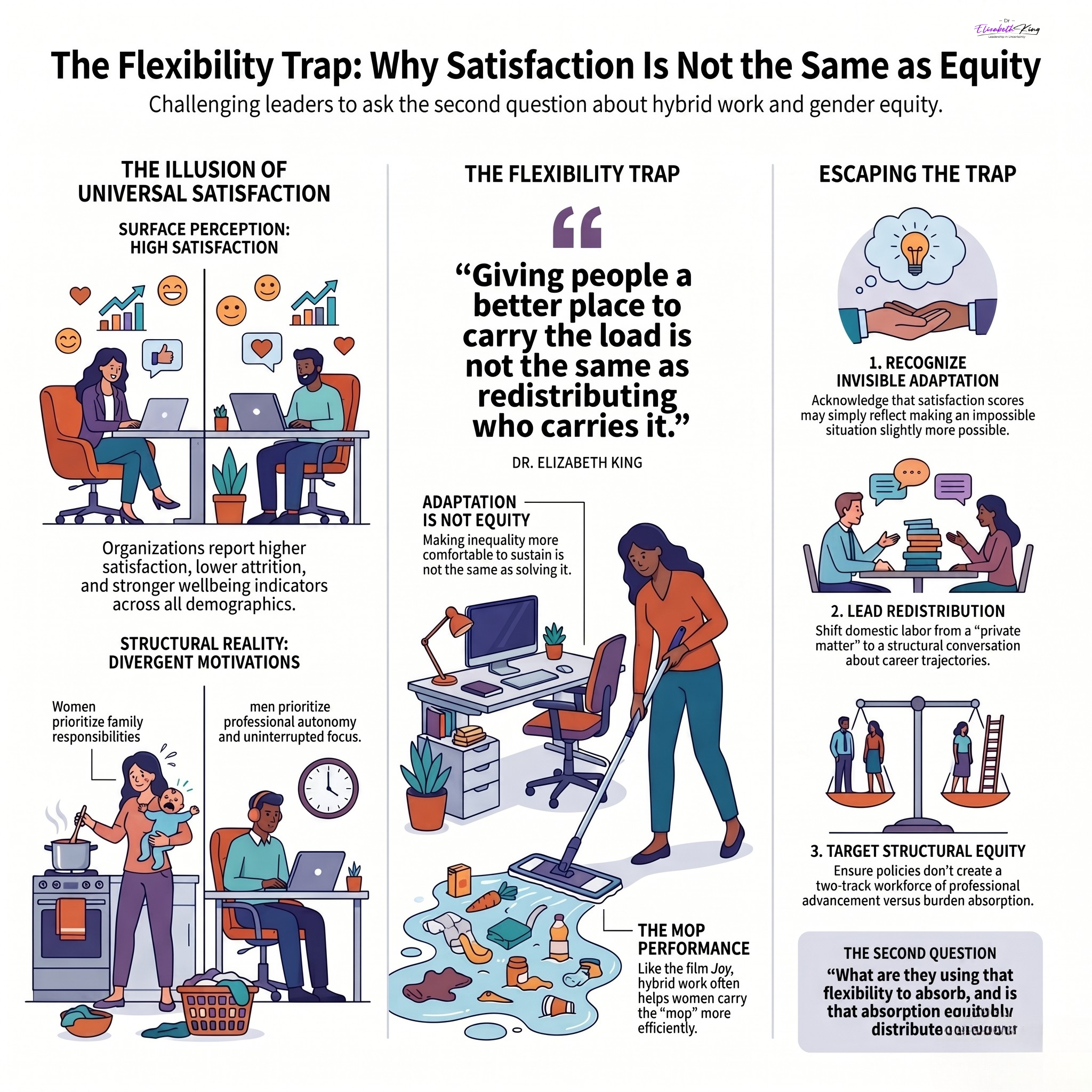
A few years ago, some colleagues and I wrote about a film, 'Joy and the Mop'. Joy tells the story of Joy Mangano, an inventor who, from humble beginnings, builds a business empire while simultaneously managing the full weight of a chaotic household, an absent ex-husband, a demanding mother, and an undermining family system. The film presents this as triumph. What we argued is that it is something more complicated: it is a performance. Joy carries the mop with remarkable skill, and the film asks us to admire her for it.
That argument has stayed with me. And lately, it has found a new setting: the hybrid workplace.
The data we celebrate
The evidence on hybrid work and work-life balance is, on the surface, encouraging. Study after study confirms that employees value the flexibility hybrid arrangements offer. Organisations that have invested in hybrid models report higher satisfaction scores, lower attrition, and stronger wellbeing indicators. For most of us, this represents a genuine and hard-won win, particularly in the wake of a pandemic that forced a fundamental rethinking of where and how work gets done.
When we disaggregate the data by gender, a richer picture begins to emerge.
Consistently, across European labour markets and beyond, women and men report valuing hybrid work for measurably different reasons. Women most frequently cite the benefit of more time for family and personal responsibilities. Men most frequently cite greater professional autonomy and the ability to focus without interruption. Both groups are satisfied. They are satisfied for structurally different reasons, and that difference is telling us something important that rewards our attention.
Preference or necessity?
Here is the question worth sitting with: when a woman in our organisation says she values hybrid work because it gives her more time for family, is that a preference or a necessity?
The research on unpaid domestic labour is unambiguous. Women continue to carry a disproportionate share of care work, household management, and what sociologists call the "mental load" of family logistics. This was true before the pandemic. The pandemic intensified it significantly. And the move to hybrid working, for all its genuine benefits, has made that load more manageable to carry alongside a laptop. That is a real improvement in daily life, and it sets up the deeper question equity asks.
When we design flexible work policies that make it easier for women to absorb domestic responsibilities alongside professional ones, we have a real opportunity to redistribute the underlying load rather than relocate it. The deeper progress lies in how we share that load. Drawing on Judith Butler's foundational work on gender performativity, gender is not fixed; it is enacted, repeated, and naturalised through daily practice. A policy that embeds women more deeply in the domestic sphere, even under the banner of flexibility, repeats and reinforces gendered expectations, one working-from-home day at a time. A policy designed with redistribution in mind does the opposite.
The performance of resolution
What is most worth examining here is the role hybrid work plays in our thinking. For many people, of all genders, it represents a genuine improvement in the quality of working life. What is worth examining is the way hybrid work has become, in many organisations, a proxy for gender equity progress. The logic runs something like this: we offer flexible working; women can now manage their family responsibilities more easily; therefore the tension between career and care is resolved. The satisfaction scores confirm it.
Satisfaction tells us an arrangement is working for people. Equity asks how the underlying load is shared. A woman managing two full-time demands (professional performance and domestic responsibility) from a single location may report being satisfied with hybrid work because it makes a hard situation more possible. That satisfaction is evidence of adaptation, and the opportunity ahead is structural change.
This is the flexibility trap. It is the organisational equivalent of handing Joy a longer cord on the mop and calling it progress.
What leadership actually requires here
Most of us who lead organisations want to do the right thing. Implementing hybrid work was the right thing. The question now is whether we are willing to go further.
The most generative shift available to us is the second question. Alongside "do our people have flexibility?" we can ask "what is that flexibility helping them absorb, and how can we share that load more fairly?" Alongside "are our satisfaction scores up?" we can ask "what would our female colleagues tell us if we asked about cost as openly as we ask about advantage?"
Genuine progress on gender equity in the context of hybrid work invites three things that flexible scheduling alone cannot deliver. First, a serious organisational conversation about domestic labour and who carries it; this is a structural matter that shapes career trajectories, promotion rates, and long-term earnings. Second, a willingness to examine whether hybrid work policies, as currently designed, support two different uses of flexibility: one group using it to advance professionally, another using it to manage responsibilities that deserve to be shared more widely. Third, the collective courage to name what is happening clearly, so the metric becomes a window into the work rather than a screen in front of it.
The mop is still there
Joy builds her empire. The film ends in triumph. And the mop is still in the frame.
Hybrid work is a meaningful improvement in how we experience our working lives, and it carries the potential to redistribute the conditions of work itself. The policy opens the door. The quality of thinking we bring to what sits behind it determines how far we walk through.
The question for all of us is this: are we genuinely redistributing the conditions of work, or are we simply giving people a better place to carry what they were always carrying?
That question rarely appears in a satisfaction survey. It is the one that moves us forward.
REFERENCES
Branicki, L. J., King, E., & Norbury, K. (2023). Joy and the mop: The role of film in doing and undoing gender in entrepreneurship. Gender, Work & Organization, 1–20. https://doi.org/10.1111/gwao.13031
Butler, J. (1990). Gender trouble: Feminism and the subversion of identity. Routledge.
Eurofound & International Labour Office. (2017). Working anytime, anywhere: The effects on the world of work. Publications Office of the European Union & International Labour Office. https://www.eurofound.europa.eu/en/publicatio…orld-work
Moens, E., Lippens, L., Sterkens, P., Weytjens, J., & Baert, S. (2022). The COVID-19 crisis and telework: A research survey on experiences, expectations and hopes. The European Journal of Health Economics, 23, 729–753. https://doi.org/10.1007/s10198-021-01392-z
Sevilla, A., & Smith, S. (2020). Baby steps: The gender division of childcare during the COVID-19 pandemic. Oxford Review of Economic Policy, 36(Supplement 1), S169–S186. https://doi.org/10.1093/oxrep/graa027
Dr Elizabeth King works with leaders navigating complexity, uncertainty, and chaos to create the conditions for genuine organisational progress.